Developer Guide
This document details the design and implementation of Jade. For documentation of each component or class with KDoc, refer to {insert link to generated KDoc HTML here}.
Decompilation
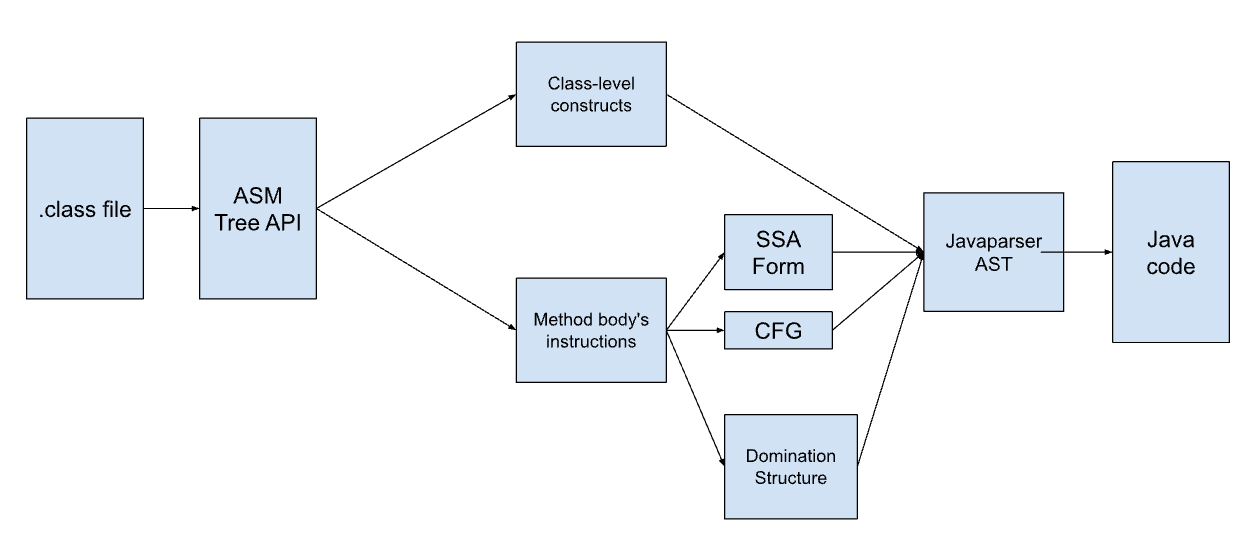
At a high level, Jade works as follows:
- First, Jade takes a path to a Java .class file as its input.
- Then, raw Java bytecodes from the .class file are read using ASM, and accessed via the ASM Tree API.
- Subsequently, Jade builds a Java abstract syntax tree using data structures provided by JavaParser.
- Bytecode sections belonging to class-level constructs (fields, method signatures, etc.) are directly translated from bytecode into JavaParser data structures.
- Bytecode sections belonging to method bodies with instructions are converted into 3 useful intermediate representations: control flow graph (CFG), Static-Single Assignment (SSA) form and CFG Dominator Structure form. Jade utilizes these three representations to construct a Java abstract syntax tree.
- Finally, the abstract syntax tree is converted into Java code and written to the output stream.
The following figure illustrates Jade's decompiling workflow:
Subcomponents
Jade's source consists of the following subcomponents:
- /analysis: Algorithms for analyzing code.
- /asm: Wrappers around ASM library, a library for manipulating JVM bytecode / .class file.
- /classfile: Code for parsing data from JVM bytecode / .class files.
- /decompile: Code for decompiling JVM bytecode.
- /javaparser: Wrappers around JavaParser library, a library for representing Java ASTs.
- /jgrapht: Wrappers around JGraphT library, a library for vertex-edge graphs.
- /main: Main command-line entry point.
- /maven: Code for downloading and testing againt Maven repositories.
- /util: Utility classes.
Parsing and Decompiling Class-level Constructs
(TODO: High-level implementation strategy & key design decisions)
Parsing and Decompiling Method Bodies
(TODO: High-level implementation strategy & key design decisions)
Computation of Control Flow Graph
(TODO: High-level implementation strategy & key design decisions)
Computation of Domination Structure
(TODO: High-level implementation strategy & key design decisions)
Computation of Static Single Assignment (SSA) Form
(TODO: High-level implementation strategy & key design decisions)
Decompilation Flow
(TODO: High-level implementation strategy & key design decisions)
Testing against bytecodes
Obtaining test data
-
To download a repository from Maven for testing and development
- Look for the desired MVN repository from MVN Repository and go to the desired version's page.
- To download
.classbytecodes of a repository, click on "jar (XXX KB)".
-
Unzip the jar file. It might be useful to filter out
.classfiles recursively using the following bash script:for i in $( find repo_extracted -name "*.class" -type f ); do echo $i cp $i repo_class_files done -
To download the original source code (in
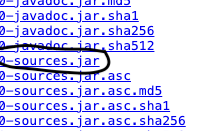
.java), click on "View All", then look for the jar file with the suffix-sources.jar. You may unzip such jar file and filter out.javafiles and copy them into a separately folder as above.

Useful medium-sized repository: - https://mvnrepository.com/artifact/junit/junit/4.13.2
Class-level constructs
The correctness of decompiling class-level constructs can be ascertained by the following process:
1) Decompile Java file with Jade using the decompile command
./gradlew run --args="decompile '<path to file>/SampleInterface.class' tmp"
javac tmp/XXX.java. If there is any dependency, download their jar file as well and include them with a -classpath parameter, for example javac -classpath denpendency1.jar:dependency2.jar:dependency3.jar: "XXX.java"
3) Decompile given test files
./gradlew run --args="decompile '<path to file>/SampleInterface.class' tmp"
tmp.
4) Compare the class skeletons of old and new bytecodes. This can be done using displayed results of javap -p -s command.
First run
javap -p -s <path to original class files> > 1.txt
Then run
javap -p -s <path to newly generated class file in /tmp> > 2.txt
Then you can do diff 1.txt 2.txt. If the class skeletons of old and new bytecodes match exactly, the decompiling can be considered correct. If the two do not match exactly, further investigation and judgment are needed.
Method body
(TODO)